You notice racket balance the first time you react late at the net. One racket feels quick and easy to move. Another gives you more punch, but suddenly volleys and defensive blocks feel a fraction slower. If you are wondering how to compare racket balance, the key is not just reading a product label – it is understanding how that balance changes the way the racket moves in your hand.
For padel players, balance is one of the biggest factors in racket feel. It affects manoeuvrability, power, comfort and how demanding a racket feels over a full match. That matters whether you are buying your first racket or replacing one that no longer suits your level.
What racket balance actually means
Racket balance is the point where the racket’s weight is distributed. In simple terms, it tells you whether more mass sits towards the head, closer to the handle, or somewhere in between.
A head-heavy racket places more weight towards the top. That usually helps generate power, especially on overheads and attacking shots. The trade-off is that it can feel slower to move and more tiring on the arm.
A head-light racket keeps more weight closer to the grip. That tends to improve control, speed in hand and comfort, especially during fast exchanges or defensive play. The downside is that some players find it gives them less free power.
An even-balance racket sits in the middle. This is often the safest choice for players who want all-round performance without the extremes of either feel.
How to compare racket balance without overthinking it
When players compare rackets, they often focus on total weight first. That is understandable, but two rackets with the same quoted weight can feel completely different if their balance points are different.
Imagine two padel rackets at 365g. One is head-heavy, the other head-light. On paper they look similar. On court, they do not. The head-heavy option may hit a heavier ball, while the head-light one may feel faster in quick hand battles and easier to control under pressure.
So if you want to compare balance properly, do not isolate it from feel. Look at balance together with total weight, shape and your usual style of play.
How to compare racket balance in practical terms
The most useful comparison starts with three questions. Does the racket feel quick or sluggish when you prepare? Does it help you on attacking shots or make them harder? And can you still handle it comfortably after an hour or more?
That matters more than chasing a single number.
Compare balance category first
Most padel rackets are broadly described as head-heavy, even-balance or head-light. Start there. This gives you a practical shopping filter straight away.
If you are a beginner, a head-light or even-balance racket is often the easier route. It helps with control and reduces the risk of buying something too demanding. If you are an experienced player with strong technique and an aggressive game, a head-heavy model may give you the extra power you want.
Then compare it against your current racket
Your current racket is your best reference point. If it feels tiring, slow at the net or difficult in defence, moving slightly more towards head-light may make sense. If it feels easy to use but lacks punch on smashes or viboras, you may want a more head-heavy setup.
Small differences matter. You do not always need a dramatic change. Going from very head-light to slightly even can already give you a stronger attacking feel without making the racket awkward.
Test swing feel, not just static feel
A racket can feel fine when you simply hold it. The real difference shows up when you mimic volleys, bandejas, serves and quick defensive reactions. Balance affects swing feel more than showroom feel.
That is why some players pick up a racket and think it seems light, then find it surprisingly demanding once they start hitting. The weight in the head only becomes obvious in motion.
Balance and racket shape work together
Balance does not act alone. In padel, racket shape has a big influence on how balance is perceived.
Diamond-shaped rackets tend to carry more mass in the upper part of the head, so they often feel more head-heavy. That usually suits attacking players looking for power, but it can punish off-centre hits and feel less forgiving.
Round rackets usually feel easier to handle and are often associated with control and comfort. Many beginners and control-focused players prefer them because they are more forgiving and generally less demanding.
Teardrop or hybrid rackets sit in the middle. They aim to blend manageable handling with useful power, which is why they are such a popular choice for improving intermediate players.
So when you compare racket balance, do not ignore shape. A head-heavy diamond racket and a head-heavy hybrid racket may both be labelled similarly, but the on-court experience can still differ.
What balance suits your playing style?
This is where buying guidance becomes useful.
If you play a control-first game, defend a lot, and value consistency over raw power, head-light or even balance is usually the smart choice. It helps you react faster and keeps the racket easier to manage during long points.
If you attack often, look to finish points overhead, and have the technique to accelerate the racket confidently, a more head-heavy setup can work well. You get extra momentum through the ball, which can make smashes and aggressive volleys more effective.
If your game is mixed, or you are still developing your identity as a player, even balance is often the safest place to start. It lets you grow without locking you into a very specialised feel too early.
Beginners
For most beginners, comfort and control matter more than maximum power. A racket that feels easy to move will help you learn timing and technique faster. If the balance is too head-heavy, you may end up fighting the racket instead of improving with it.
Intermediate players
Intermediate players often benefit most from subtle tuning. This is the stage where you may start noticing whether your racket gives enough help in attack or enough speed in defence. Hybrid and even-balance models are often strong options here because they support all-round improvement.
Advanced players
Advanced players can be more specific. If your game is aggressive and physically strong, a head-heavy racket may suit you. If you rely on placement, quick transitions and precision at the net, you may still prefer something more neutral or slightly head-light.
Comfort matters more than many players think
A racket that looks perfect on paper can still be the wrong choice if the balance wears you out. This is especially true if you play regularly or have any history of elbow, wrist or shoulder discomfort.
Head-heavy rackets can place more load through the arm, particularly if your timing is inconsistent or your technique breaks down late in matches. That does not mean you should avoid them completely. It just means you should be honest about your physical comfort and playing frequency.
Sometimes the best racket is not the most powerful one. It is the one you can use confidently for every match.
Common mistakes when comparing balance
One common mistake is assuming heavier always means more powerful. In reality, a lighter racket with a head-heavy balance can feel more powerful in attack than a heavier racket with a head-light balance.
Another mistake is copying advanced players too closely. If a top-level player uses a demanding, head-heavy racket, that does not automatically mean it is right for your game. Better players can handle more specialised setups because their timing and technique are sharper.
The third mistake is treating balance as a separate spec instead of part of the full package. Core material, surface feel, shape and weight all influence the final result.
The easiest way to shop smart
If you are buying online, the simplest route is to narrow your choice by level and playing style first, then compare balance within that smaller group. That cuts out a lot of noise.
For example, if you are an intermediate player who wants a bit more attacking help but still values control, there is no point comparing every racket on the market. Focus on hybrid or teardrop models in a manageable weight range, then look at which ones lean slightly head-heavy and which stay more even.
That kind of comparison is much more useful than chasing broad marketing claims.
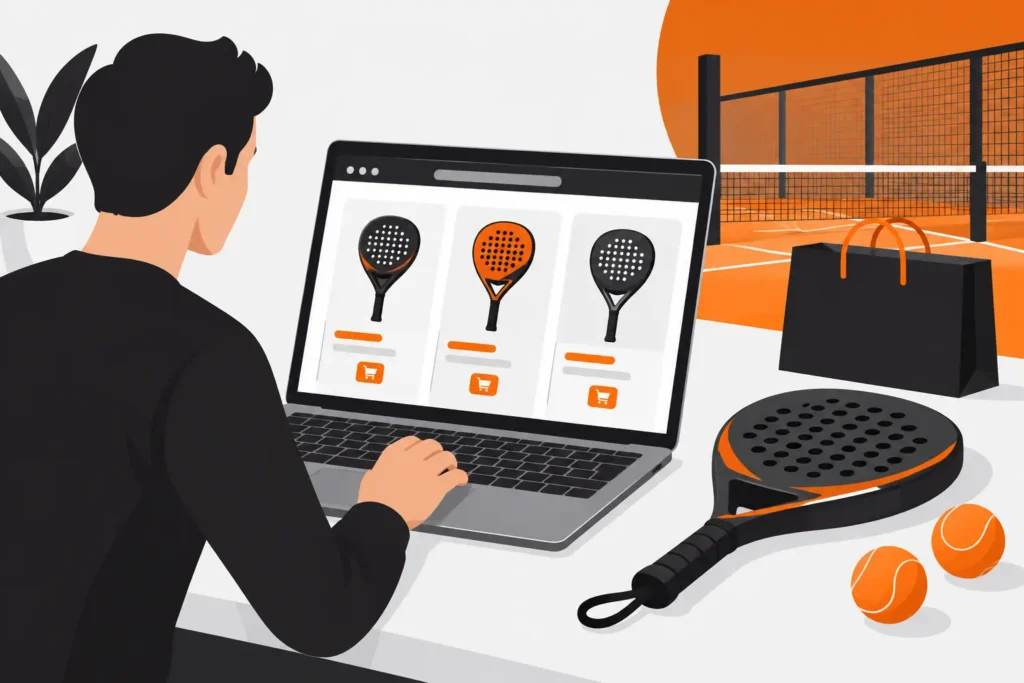
A store that sorts rackets by beginner, intermediate and advanced level, as well as control, hybrid and power categories, makes this much easier. That is the idea behind how we help players shop at 7padel – less confusion, better fit, and no need to pay over the odds for recognised brands.
A simple rule if you are stuck
If you are between two options and cannot decide, choose the easier racket unless you are very sure you need more power. Players usually improve faster with a racket they can move confidently and repeat shots with, rather than one that feels impressive for ten minutes and demanding after two sets.
The best balance is the one that supports your game today while still giving you room to improve. Get that part right, and every shot starts to feel a bit more natural.